
Key Points
-
Angst about economic conditions has been running high in recent times. This is evident in chronically low consumer confidence readings and a downtrend in measures of happiness. It’s also arguably evident in the rise of populist parties globally and more recently in Australia.
-
There is no doubt that some things were better a generation or two ago. Cheaper housing stands out. But most indicators are far superior today.We are continuing to allow for a further rate hike in August and have another one pencilled in for November reflecting the still rising trend in underlying inflation and risks that it will take longer to bring it back under control.
-
That said there is no denying that “cost-of-living pressures” have been a problem in recent years and a key driver behind this has been poor productivity growth. Unfortunately, there are no quick and easy fixes to this.

Introduction
Lately, there seems to be a heightened level of angst that economic conditions are getting harder and that the two-party political system – and maybe democracy too – is failing voters. There seems to be a hankering for times past that some feel were better. There is no doubt that “cost-of-living” issues have become real in the post-pandemic years. This has been associated with relatively stagnant real household disposable income and poor productivity growth over the last decade. Unfortunately, there are no quick fixes to this. Rather getting productivity up requires hard-nosed economic reforms that may take years to bear fruit. But while the Australian economy does have some real challenges to address, it is worth keeping things in perspective. This note looks at how economic conditions in Australia have changed over the last half century.
Some things are worse today
The table below provides a brief comparison of economic indicators where conditions were better 25 and 50 years ago. These periods were chosen because the 1970s broadly coincided with baby boomers entering the workforce, while Millennials entered in the 2000s and Gen Z in the 2020s.
The bad news – now and then
|
|
1975 |
2000 |
Latest |
|
Consumer sentiment, index level |
105.0 |
102.2 |
80.6 |
|
Average home price to wage ratio |
5.5 |
6.4 |
14.4 |
|
Years to save for a home deposit |
<4 |
5.8 |
11 |
|
Home ownership rate, % |
62.7 |
66 |
63 |
|
Income tax, % of gross household income |
11.3 |
18.7 |
21.6 |
*decade average. Source: ABS, Westpac/Melbourne Institute, Cotality, AMP
The bad news is that consumer sentiment seems to be stuck around much lower levels, despite the absence of really high unemployment as seen in the recessions of the 1980s and 1990s. And associated with this over the last 20 years happiness has been trending down. From the next chart it can be seen that the trend in both has been down since around 2015, not just the last few years.
Aussies are becoming more pessimistic
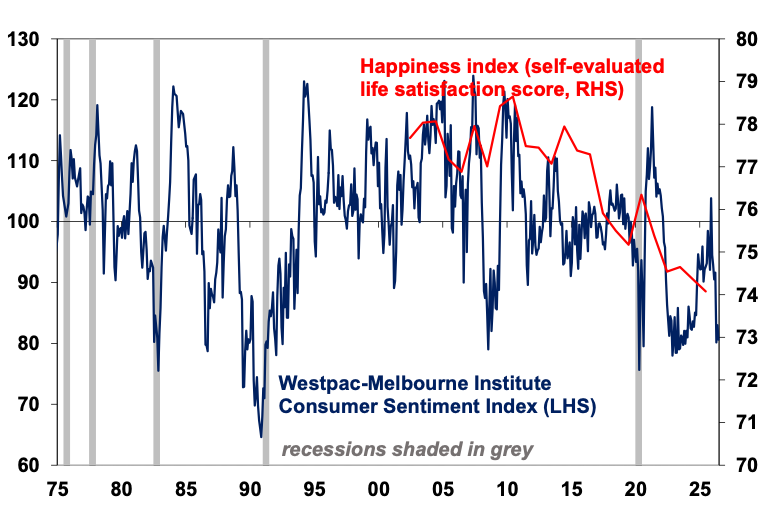
Source: World Happiness Report, Bloomberg, ABS, Westpac-Melbourne Institute, AMP
We also paid less tax as a share of our income back then. But housing is the big one – today the ratio of home prices to incomes is way above what it was 25 and 50 years ago, and it takes far longer to save for a deposit. Associated with this has been a down trend in the home ownership rate since it’s mid-1960s peak. And this arguably goes a big way to explain why younger generations may be feeling less happy today as getting a home is seen as too hard.
Home ownership versus home prices relative to incomes
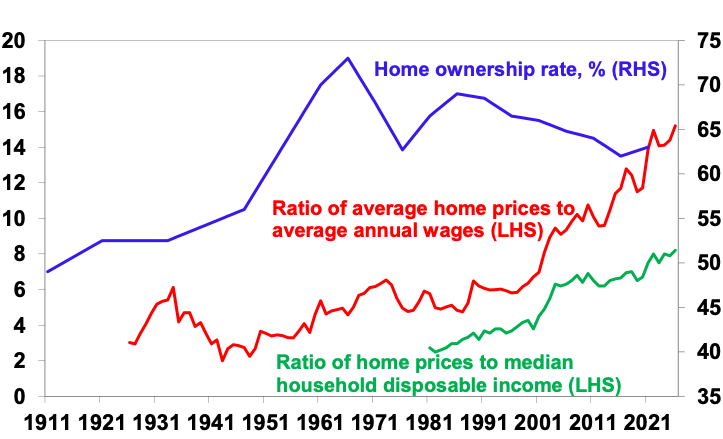
Note home ownership data is only available from 5 yearly census. Source ABS, Cotality, AMP
Of course, in the past things were also less regulated so we may have felt freer, there was a greater sense of community, there was less choice (i.e. four TV channels in the 1960s and 70s versus lots of streaming and TV options now), so less decisions to make, which resulted in less pressure. And there was no social media to bully us, rile us up or create a perpetual sense of FOMO (and in many cases relieve us of our money – though small town gossip was probably worse back then!).
But many economic indicators are far better now
Against this, virtually all other economic indicators are much better today.
The good news – now and then
|
|
1975 |
2000 |
Latest |
|
Per person GDP, real dollars |
11,283 |
18,540 |
24,917 |
|
Real net household disp income per person |
$30,602 |
$40,803 |
$61,065 |
|
Inflation rate, % |
15.3/9.8* |
15.3 |
4.0 |
|
Unemployment rate, % |
5.4/3.9* |
6.3 |
4.4 |
|
Employment to population, % |
59.3 |
59.1 |
63.7 |
|
Female participation rate, % |
44.8 |
54.4 |
62.8 |
|
Gender pay gap (full time), % |
~35 |
15 |
12 |
|
University participation, 18-19 yrs, % |
~20 |
|
40 |
|
Life expectancy, males, years |
69.4 |
76.6 |
81.1 |
|
Life expectancy, females, years |
76.4 |
82 |
85.1 |
|
Govt spending on health, aged, disability & welfare, % GDP |
7.0 |
12.5 |
15.0 |
|
Overseas holidays, per 100 people, yr |
6.3 |
17.9 |
45.1 |
|
Motor vehicles, per person |
0.49 |
0.65 |
0.81 |
|
Road deaths per 100,000/yr |
26.6 |
9.5 |
4.8 |
|
Homicides per 100,000/yr |
~1.9 ^ |
1.8 |
1.0 |
|
Suicide rate per 100,000/yr |
12.6 |
12.4 |
11.8 |
|
Foreign born population, % |
19.9 |
23 |
32 |
|
Foreign born population from UK & Europe, % |
17.0 |
12.3 |
8 |
* decade average. ^ homicide rate then peaked at 2.4 in 1988.
Source: ABS, PBO, AIC, BITRE, AIHW, AMP
In recent decades the economic cycle has been milder with less severe recessions, generally lower unemployment and generally lower inflation. Today we are far better off materially: real household income is double what it was 50 years ago, there is a greater share of the population in employment (~64% versus 60% in the 70s, reflecting more jobs), and the female participation in the workforce has risen (helped by better education, childcare and attitudes).
Australia Employment to Population Ratio
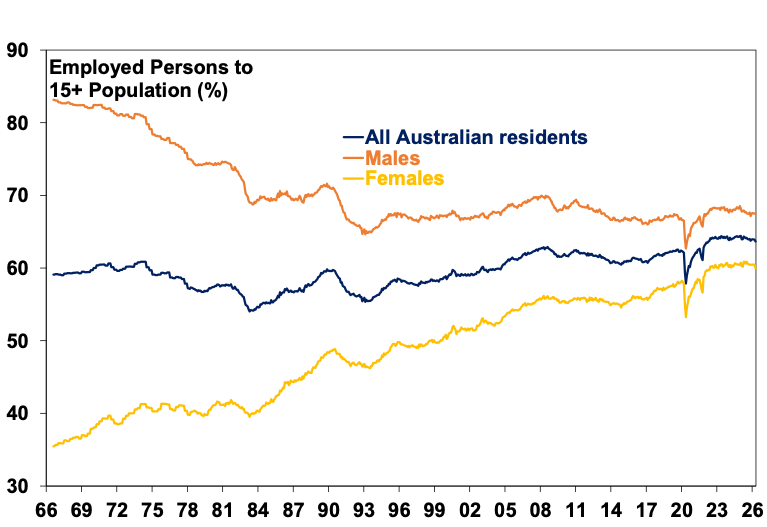
Source: ABS, AMP
With this wealth has come more discretionary spending power to devote to things like overseas holidays – 50 years ago, an average Australian had an overseas holiday once every 16 years, now it’s just a bit less than once every two years. And more gadgets like cars – where there is now nearly one for every two people – and household appliances like huge flatscreen TVs. And multiple cafes per suburb with endless choice of coffee and food compared to the burgers and instant coffee of a few generations ago.
Aussies are travelling abroad more than ever
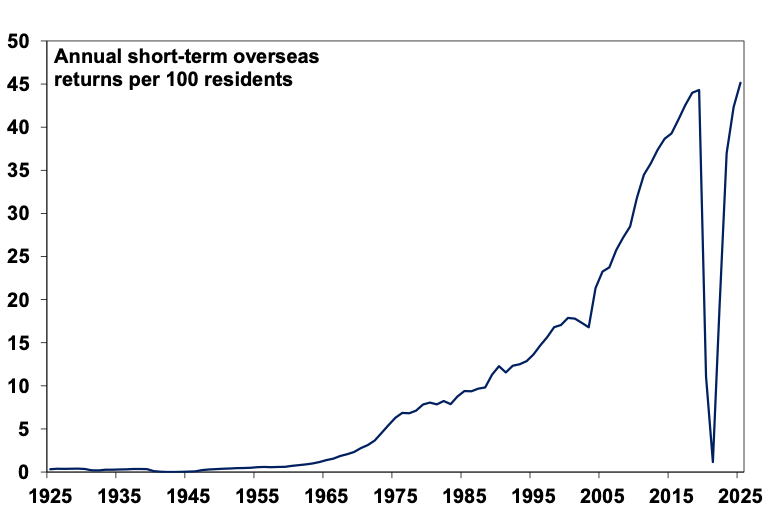
Source: ABS, AMP
But it’s also a far more equitable society. For example, female participation in the workforce has surged from being way below that of men, more girls now go on to a university education than boys and the gender pay gap has fallen sharply (albeit there is still a way to go). It’s hard to look back a generation or two ago and say things were great when opportunities for half the population (i.e. women) were way below those of the other half. At this point we hear the manosphere crowd saying how guys are now discriminated against…and think come on guys “get a grip”! – don’t you realise that manosphere influencers are just telling you what you want to hear so they can get a buck out of you!
Average weekly earnings for males & females
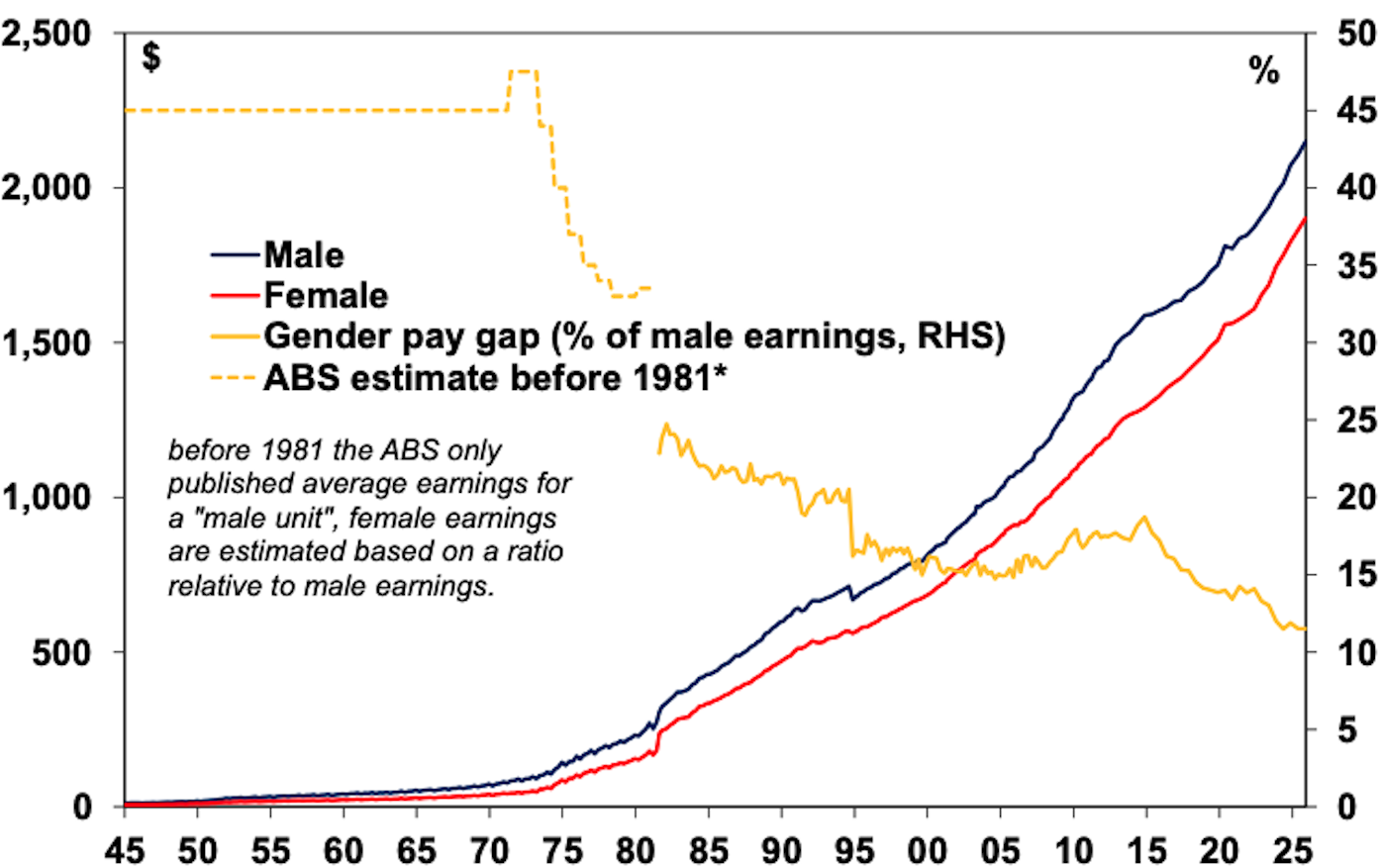
Prior to the 1971 female wages were not really surveyed but assumed to be a fixed ratio to male wages. Source: ABS, AMP
And with this surge in income and wealth has come huge medical advances which means we are living longer, active lives. (Of course, this is not to say there are not issues with obesity and too much sugar which may be starting to take a toll in the last few years!)
Australian life expectancy at birth
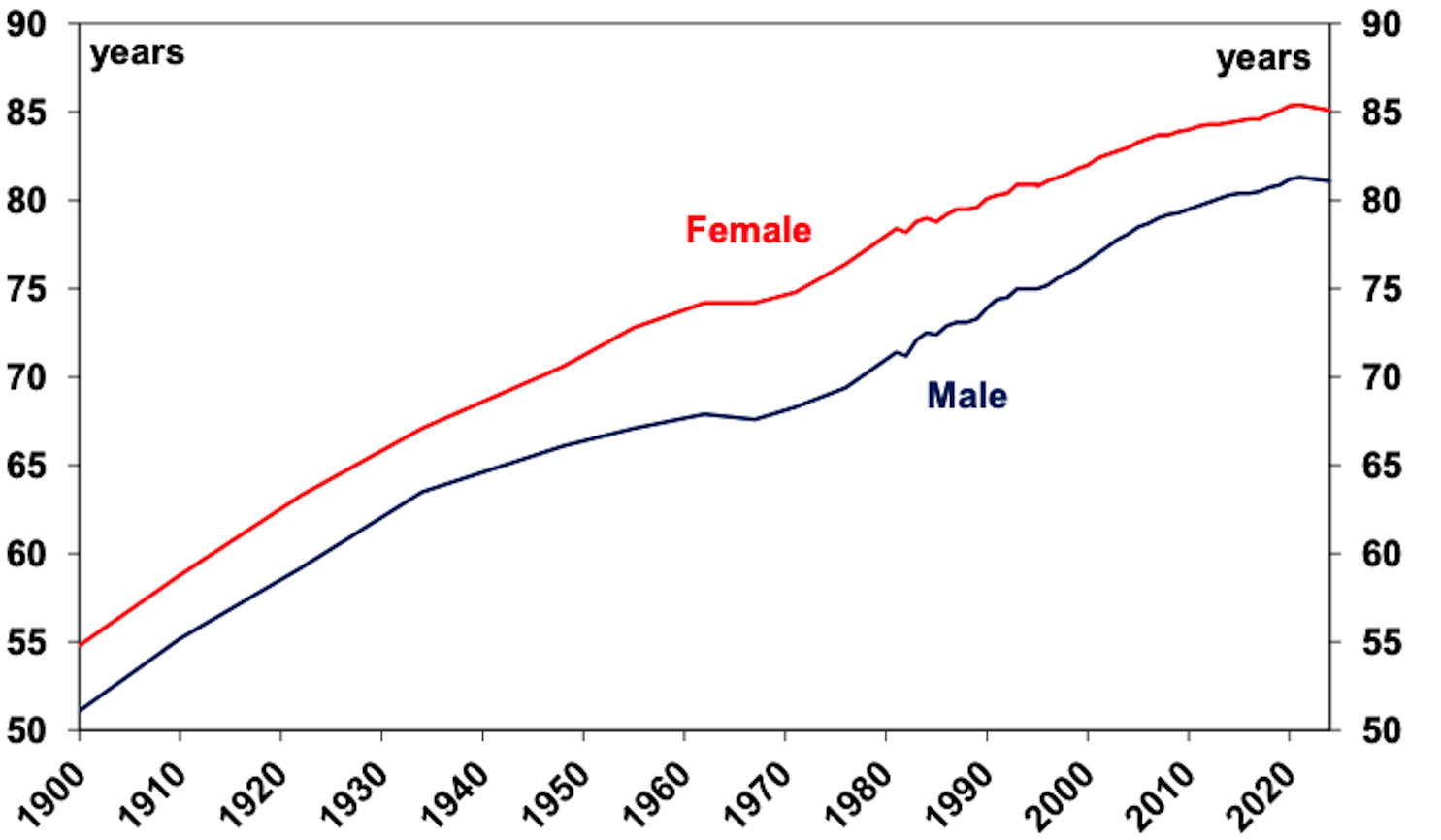
Source: ABS, AMP
While we pay more taxes as a share of income, and more is demanded of Government, the social safety net is bigger than ever. It’s seen explosive growth in the provision of spending on welfare, health, aged and disability care – which have each more than doubled as a share of GDP. And Government is mostly doing a good job of protecting us from ourselves and each other, with for instance, a collapse in road death and homicide rates.
Federal Government Spending
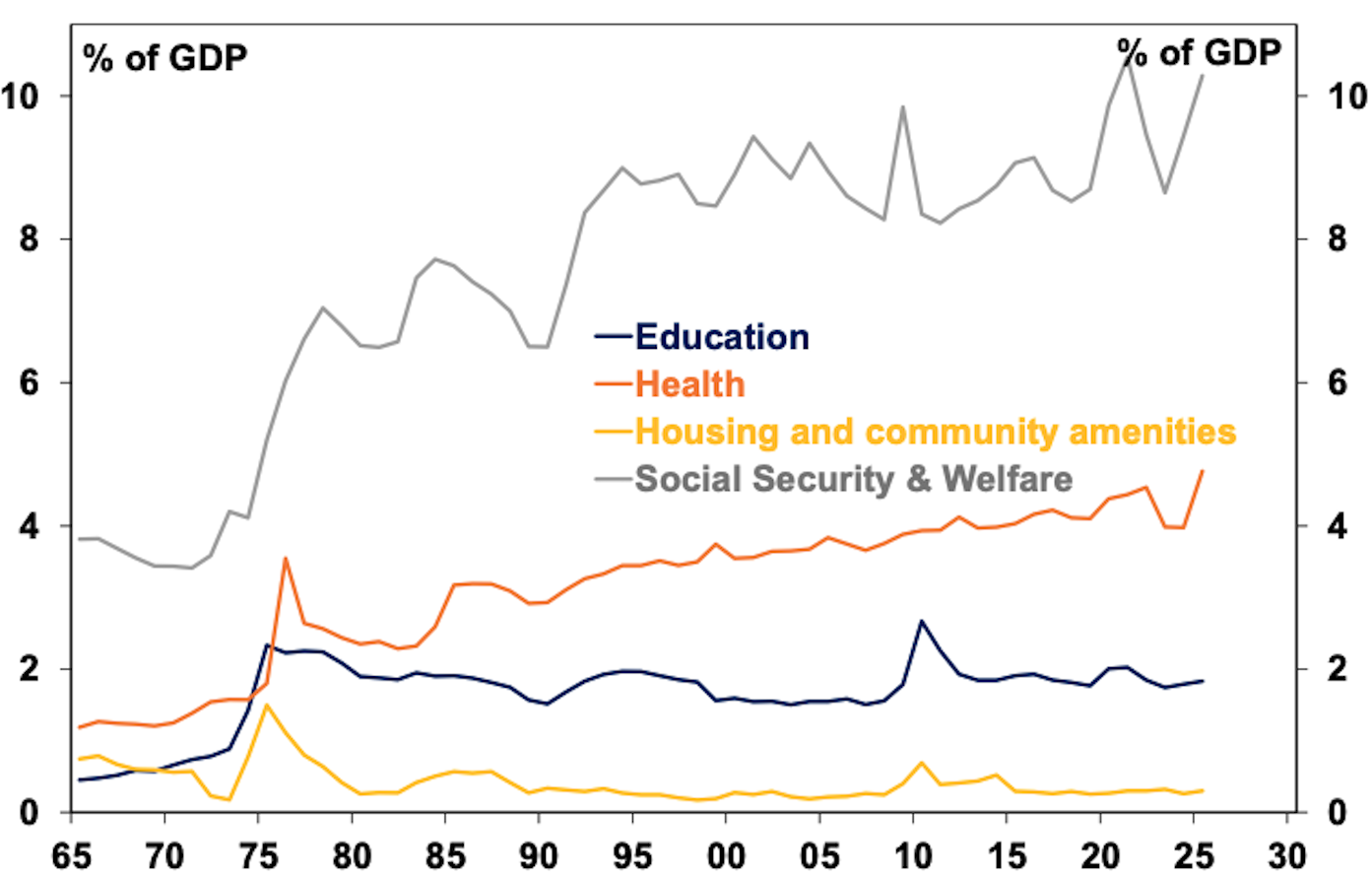
Note spending on disability care is included in Social Security & Welfare. Source: PBO, ABS, AMP
Australia is now also a far more diverse country with far more born overseas and less of those that are from a UK/European background. This has led to a richer society (e.g. more restaurants to choose from), a more innovative society and relief from the pressures of an aging population and labour shortages.
% of Australian population born in…
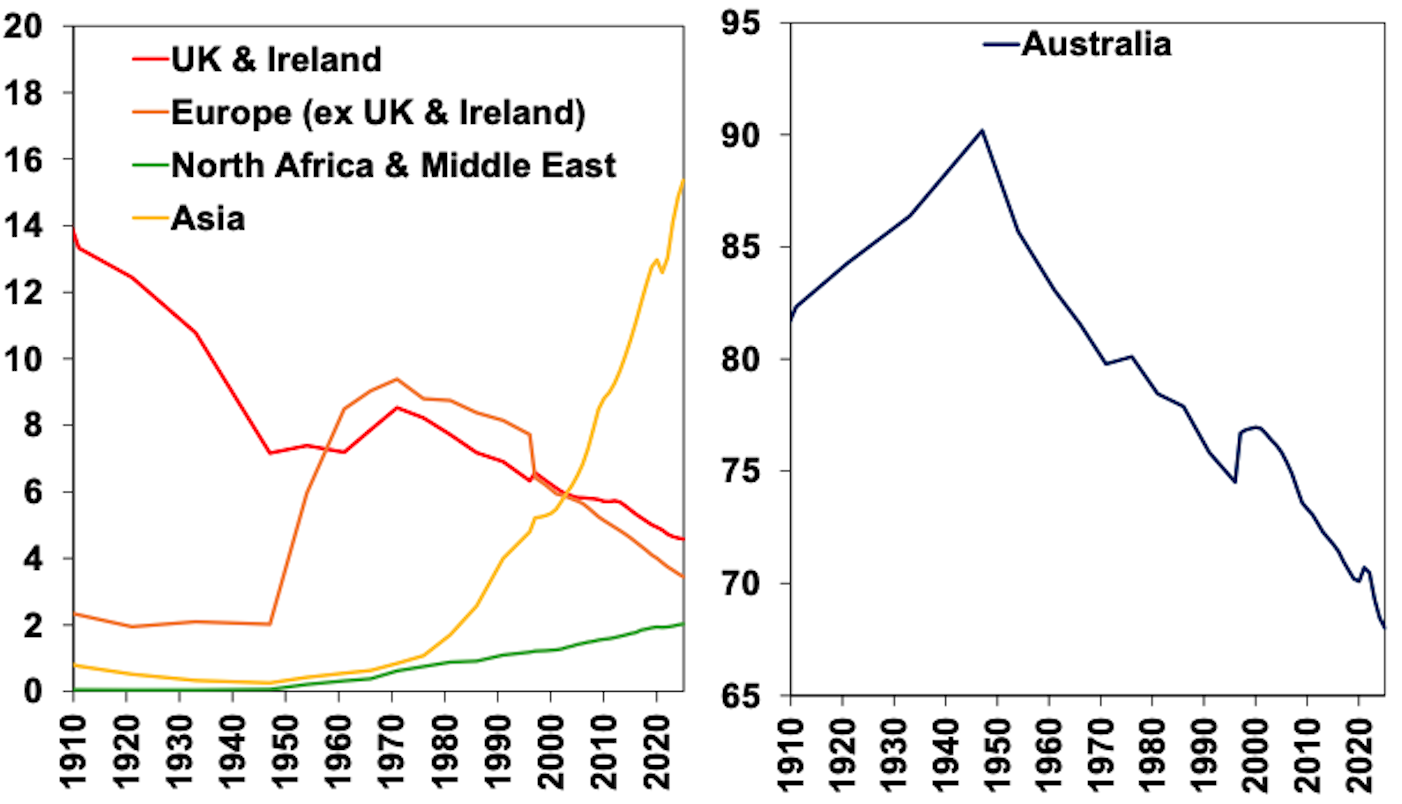
Source: ABS, AMP
Of course, immigration is once again a hot topic – it has been periodically for as long as I can remember – but for most this seems to reflect a concern about poor housing affordability.
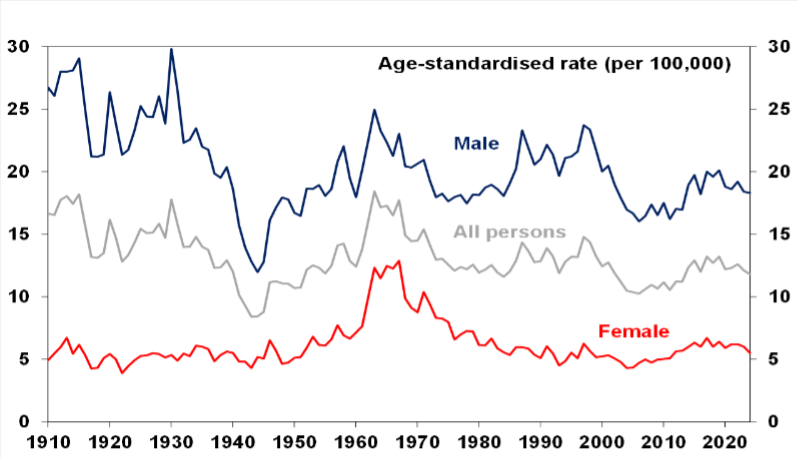
And finally, despite all the talk to the contrary, it’s still too high but the suicide rate is around where it was 25 and 50 years ago and is in fact below its level in the pre-WW2 years, the 1960s and the late 1980-90s.
Suicide deaths in Australia
Source: AIHW, AMP
So why do people still feel miserable even with all these economic achievements?
Simply because most people nowadays weren’t around back then! Around 65% of the population was born after 1975, and 78% were either not born or too young in the 1970s to remember it clearly, so much of the hardship discussed in this note sits outside most people’s lived experience. And recency bias means that even for those who were around “back then”, the tougher times they might have had can be hard to recall after three decades of economic growth and virtually no recessions in Australia.
Recency bias and higher baseline expectations also make comparisons with 25 or 50 years ago less meaningful. At the same time, things have indeed gotten a bit worse in the last 5 years.
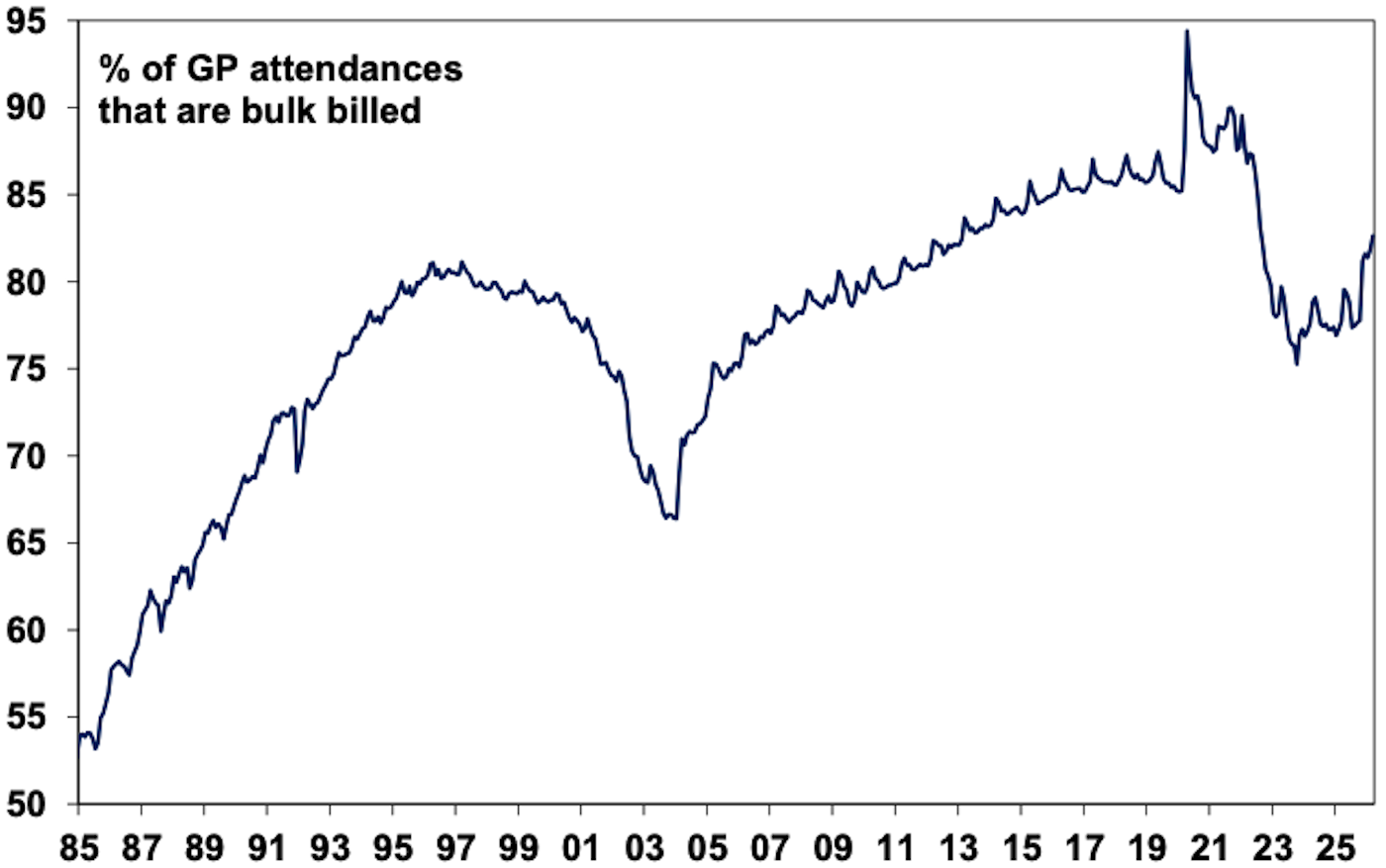
For example, health outcomes have improved over the long term, helped by medical advances, increased government health spending and better access to health care with e.g. higher bulk billing rates. But bulk billing fell sharply from 2022 until late last year as medical goods and services costs rose, with some surveys suggesting many people delayed medical appointments because of affordability. That marks a clear regression from 2020-2022, when the average bulk billing rate was 89%.
GP Bulk Billing Rates since the start of Medicare
Source: AIHW, AMP
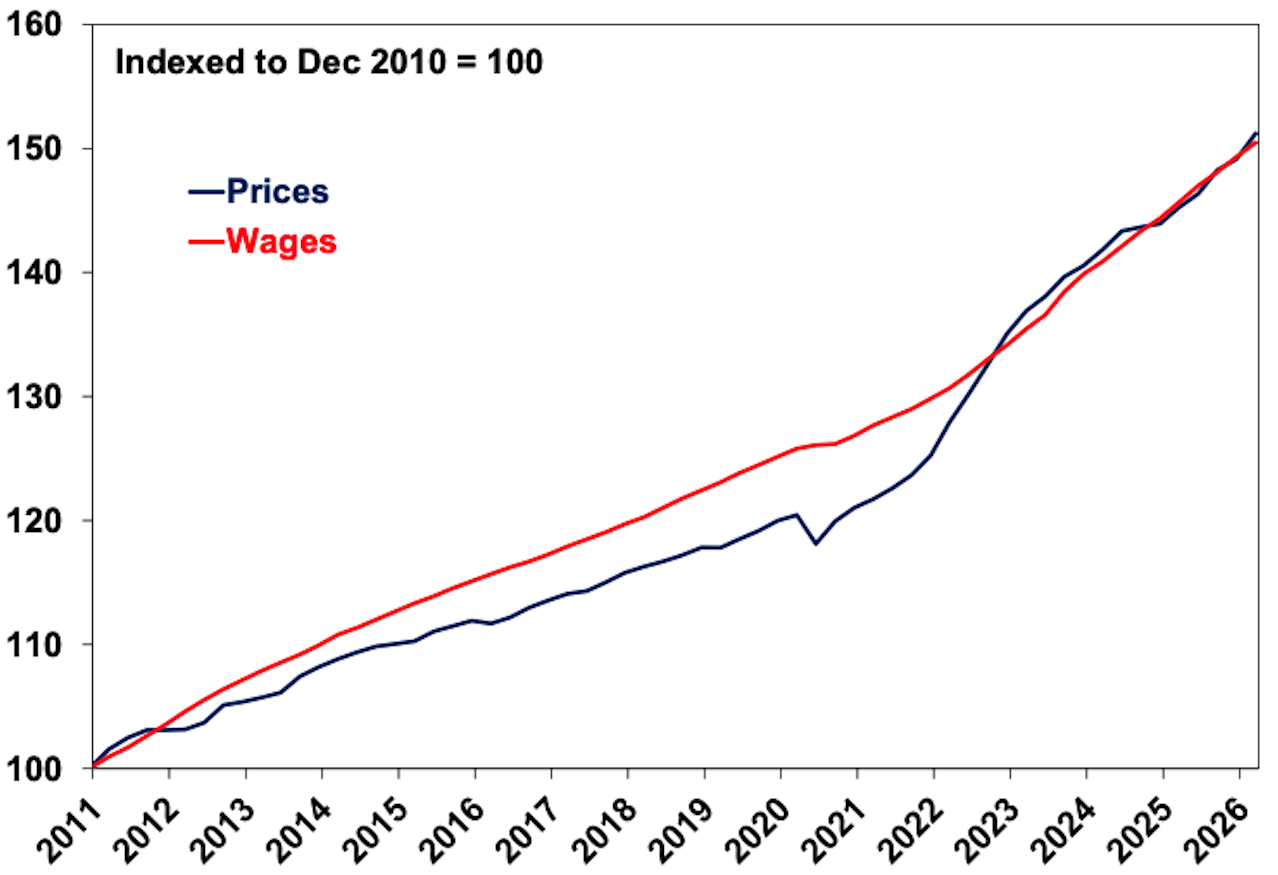
In addition, real wages have gone up significantly over the last 25 and 50 years, but the average wage earner (if they have not upskilled or changed jobs) has seen their pay lag inflation since 2021.
Australia Inflation vs Wages
Source: ABS, AMP
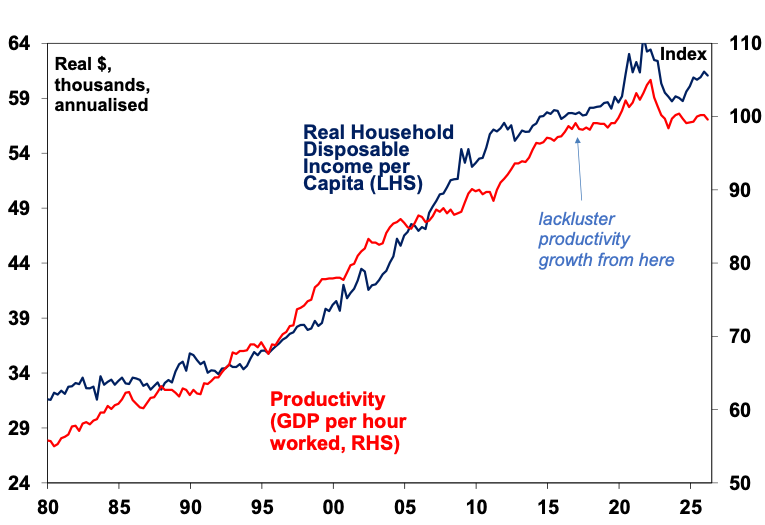
The root core of this is low productivity growth. Coincidentally, the structural decline in happiness in 2015 started around the same time productivity started stagnating.
Australians’ Living Standards
Source: ABS, AMP
Concluding comments
None of this analysis is to deny that many are struggling with “cost of living” issues and that there is a wider malaise of dissatisfaction. Government’ need to do more to boost productivity and hence grow living standards and avoid the delusion that the answer is even more government. But we suspect a big part of the problem is poor housing affordability which leads to a growing wealth gap between the haves and the have nots – fix that with a fundamental rebalancing of underlying housing supply and demand, and a lot of the angst will likely fade. This likely involves getting the balance right on immigration but not slashing it such that it just leads to labour shortages and the economy struggling with an aging population.
Finally, we need to recognise that part of the malaise associated with poor happiness and confidence reflects a problem of success. The rise in affluence has led to higher expectations than the economy can at times deliver upon. And social media – itself a product of technological success – may be contributing to the malaise via its focus on grievance and quick hits. Finding better ways to live with this success – and recognise more “things” won’t necessarily make us happier – is probably key.
Dr Shane Oliver – Head of Investment Strategy and Chief Economist, AMP
Important note: While every care has been taken in the preparation of this document, AMP Capital Investors Limited (ABN 59 001 777 591, AFSL 232497) and AMP Capital Funds Management Limited (ABN 15 159 557 721, AFSL 426455) make no representations or warranties as to the accuracy or completeness of any statement in it including, without limitation, any forecasts. Past performance is not a reliable indicator of future performance. This document has been prepared for the purpose of providing general information, without taking account of any particular investor’s objectives, financial situation or needs. An investor should, before making any investment decisions, consider the appropriateness of the information in this document, and seek professional advice, having regard to the investor’s objectives, financial situation and needs. This document is solely for the use of the party to whom it is provided.